Wednesday, 27 March 2013

Learning the Lingo

Owning a Raspberry Pi automatically earns you a place in a huge, vibrant, buzzing community that's forever growing and creating. The grand master Eben Upton, co-inventor and founder of the RPi and the Raspberry Pi foundation, has created something that can instil wonder and awe, as well as excitement and curiosity from the moment a Pi is placed into your hands. His wife, Liz, runs the Raspberry Pi website; quite possibly the only blog on the internet to be updated multiple times a day by the same writer! It's fantastic!

The forums are filled with endless streams of questions and answers on the most obvious of queries, to the tiniest troubleshooting problems. And EVERYONE is so friendly. I plucked up the courage to ask about building a robot vehicle, for complete novices, and was greeted with a reply practically the next day. It's really helped me with researching hardware for my robot.

It has also spurred my interest in and awareness of what people are doing in their free time. The country is filled with hacker communities working on big, ambitious projects, as well as parent-child teams spending their evenings together fiddling around and inventing wonderfully simple but oh-so-cool applications for the Pi.

I can't believe I didn't get involved sooner! I've missed so much and now I'm abso-blooming-lutely buzzing for my robot adventures. Smiley-face emoticon is required, me-thinks. :D

Anyhoo, the purpose of this post was to record a bit of terminology I've picked up over the past few weeks. It's kind of ESSENTIAL if you want to understand some of the convos on raspberrypi.org! These definitions are from motoman.com, my new dictionary-go-to:

Closed-Loop : Control achieved by a robot manipulator by means of feed-back information. As a manipulator is in action, it's sensors continually feed-back information to the robot's controller which are used to further guide the manipulator within the given task. Many sensors are used to feed-back information about the manipulator's placement, speed, torque, applied forces, as well as the placement of a targeted moving object, etc.

Compliant Robot: A robot that performs tasks, with respect to external forces, by modifying its motions in a manner that minimizes those forces. The indicated or allowed motion is accomplished through lateral (horizontal), axial (vertical) or rotational compliance.

Controller System: The robot control mechanism is usually a computer of some type (THE RPI), which is used to store data (both robot and work environment), and store and execute programs, which operate the robot. The controller system contains the programs, data, algorithms; logic analysis, and various other processing activities, which enable it to perform.


CPU (Central Processing Unit) : The main circuit board and processor of the Controller System.

Encoder: A feedback device in the robot manipulator arm that provides current position (and orientation of the arm) data to the controller. A beam of light passes through a rotating code disk that contains a precise pattern of opaque and transparent segments on its surface. Light that is transmitted through the disk strikes photo-detectors, which convert the light pattern to electrical signals.

Feedback Sensor: A mechanism through which information from sensing devices is fed back to the robot's control unit. The information is utilized in the subsequent direction of the robot's motion.

Robot Programming Language: An interface between a human user and a robot, which relates humans commands to the robot.

Servo-System: A system in which the controller issues commands to the motors, the motors drive the arm, and an encoder sensor measures the motor rotary motions and signals the amount of the motion back to the controller. This process is continued many times per second until the arm is repositioned to the point requested.

There is so much more, but this is just a taste of the lingo I promise myself I will learn, so that I can use it in my EPQ project and sound really awesome and fancy. Obviously, there is immense educational benefit to learning this but there is a small superficial motive as well...!

Sites used: http://www.motoman.co.uk/

Friday, 1 March 2013

Quick Note! Adafruit Industries

Adafruit.com, home to Adafruit Industries, sell a brilliant range Pi Accessories and also their own starter kit. It's £100+ but if I had that kind of money to spare, I'd buy it in a heartbeat. If you're interested, check it out here, looks very coool.

Sites used: http://adafruit.com/

Do I buy a kit? Or do I put together my own...?

I'm planning on purchasing my Pi this weekend, provided everything goes to plan. I'm not sure whether to order one from the original distributors, Farnell, only because the Pi website recommend them, or whether to buy a kit off Amazon or elsewhere.

I'm trying to find out what exactly I'll need to get started. The Raspberry Pi itself is not enough to really do anything, so I've found a list of 'necessary' additional items to purchase as well (necessary used here in the loosest way possible, mind):

- One SD card
- An SD card reader so you can write the OS image to your SD card
- A means of supplying power to the unit (an old phone charger will do). At the very least, you'll need a 5V micro-USB adaptor.
- An HDMI cable and HDMI-to-DVI converter if you're using a monitor instead of a HD TV. If you're just using a TV or a monitor that supports HDMI, you won't need an adapter.
- A USB mouse and keyboard
- An Ethernet cable

This list was found on engadget.com

With regards to the SD card, you can buy cards with the Raspbian OS loaded on already, so I think that's the best plan. But the mouse and keyboard... I'm not sure they are a priority; I have keyboards and a USB mini-mouse hanging about at home already, so if needed, I'm sure they'll do the job. I also own HDMI cables for things like Blu-Ray players and our PS3. HOWEVER, I definitely need a means of providing power so that needs looking into.

Maplin sells a Starter Kit for £74.99. A bit more money than I was intending on spending initially, but if I'm sure everything included will be of use, I am very tempted. It includes:

 AC-powered 4-port USB hub (useful)
▪ USB keyboard and optical mouse (already own)
 2.1A twin USB mains power supply (nice)
▪ 1.5m gold-plated USB A to micro B cable to power Pi
▪ 1.5m gold-plated HDMI cable (already own)
▪ N150 Nano W-Fi dongle for wireless connectivity! (I like this a lot)

And finally, good old Amazon, a handy little set (with Model B Pi) for just £52.50 (so far the most convincing):

▪ PCSL Power Supply
▪ HDMI Cable (already own)
▪ PCSL Special Edition Raspberry Network Cable
 8GB SDHC with Wheezy
▪ PCSL Special Edition Cherry/Clear Case

^ the HDMI will be an unnecessary purchase, and I would ideally like a Wi-Fi dongle, but the Model B Pi plus all of that is very reasonable! Now for a very long think...

Sites used: http://www.maplin.co.uk/raspberry-pi-board-and-starter-kit-652805
                 Amazon Starter Kit link
                http://www.engadget.com/2012/09/04/raspberry-pi-getting-started-guide-how-to/

Thursday, 28 February 2013

I Want a Slice of Pi

After my initial research into the Pi and its uses earlier this week, I had a meeting with my supervisor. He thinks I should definitely pursue my interest in a robot build, but stick with the Pi. So here's my loose project title idea:

'Is it Possible to Use a Raspberry Pi to Program a Robot?'

I know, I know, seems a bit....nnnnh.
I realise that the question seems very obvious at this point. I know it is possible to program a robot with a Raspberry Pi. When designed, I assume that was one of the potential uses the creators has envisioned.

But, more importantly, my EPQ is carried out by me, myself and I. My title really means, 'Is it Possible for Me to Use a Raspberry Pi to Program a Robot?' Because this will be my introduction into robotics; I am an ABSOLUTE NOVICE. I have no experience with circuit boards, programming, robots, electronics - zilch.

Also worth noting, my initial title will not be my final project title. It is normally common for students to tweak and refine their titles as they delve deeper into their topic and decide to follow a specific tangent or specify in a certain area. I will most likely being specifying what purpose I want my robot to have.

My supervisor was brainstorming and suggested a robot that guided a blind person around their home. I'm not sure at this point whether this would be using colour/touch sensors, or by programming certain patterns of movement. Regardless, this did raise the question: what will I be programming my robot to do? I'd rather it have a useful application than it just be moving around an obstacle course, although that would be great fun designing and testing!

To conclude all these ideas and thoughts, I need to buy myself a Raspberry Pi (still deciding on whether Model A or B!) and familiarise myself with how it works, how to connect it to other devices and then start learning some code. I think the code most commonly used with the Pi is called Python but I need to get a hang of the jargon on the forums first!

I'll update this when I purchase my Pi. I'm so excited!

LED Matrix Display by adafruit.com programmed with Pi.

Introducing the Raspberry Pi

My supervisor is aware of my interest in robotics, and has introduced me to the idea of programming. To do this, I could use a piece of hardware called a Raspberry Pi.


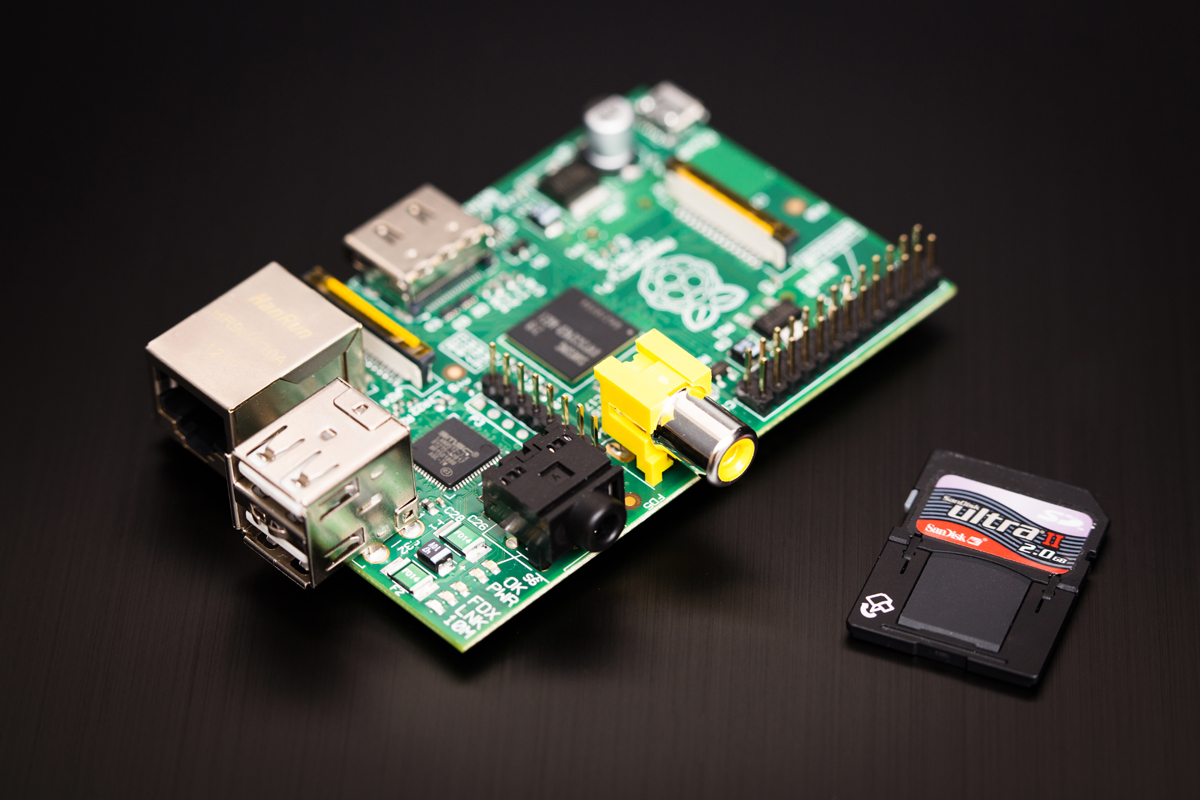
This beautiful little piece of technology is a, according to Wikipedia, "credit-card sized single-board computer". A single-board computer, or SBC, is a complete computer, but built on a single circuit board. It can plug into your TV, or keyboard, as it has USB ports, and is capable of many of the task your normal desktop computer can do, such as run spreadsheets, games and play HD video. It is obviously considerably cheaper, smaller and lighter than a desktop computer, and was designed with the aim of encouraging children to get interested in computer programming.

But don't be fooled by it's original purpose; the Pi has delighted a wide range of adults, including a number of  brilliant robot hobbyists with far too much free time, who have used the Pi to achieve some incredible things.

I found a few awesome uses:

1. the MoccaPi - a coffee machine controlled by a Raspberry Pi
2. a quadcopter - programmed by a Raspberry Pi
3. an LED Matrix - sequences and sound programmed by a Raspberry Pi

and these are but a few of the fantastical ideas conjured up by the Pi's fanbase.

Sites used: http://en.wikipedia.org/wiki/Raspberry_Pi
                 http://www.raspberrypi.org/about
                 10 coolest uses of RPi
                 http://moccapi.blogspot.com
                 http://www.raspberrypi.org/archives/3364
                 Youtube Raspberry Pi powered Quadcopter

Initial Thoughts, Has To Be Robots


When the idea of completing an Extended Project Qualification for the AQA Bacc was first put to us, my thoughts went straight to robotics.


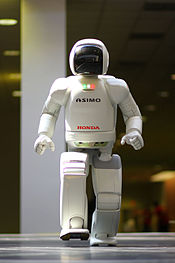
The EPQ allows complete freedom to choose a topic that interests you and for me, that's robotics and technology. Having read the New Scientist for a few years now, I noticed that I was always drawn to the work on machines, systems, AI and robotics. So when I was given the chance to spend 120 hours on a topic that interested me in order to achieve a qualification, the picture on the right came to mind!

Asimo is responsible for piquing my interest. He featured on my much-loved QI, and also appeared in James May's Big Ideas programme on robotics and humanoid robots. It was a new, exciting innovation and I thought it was brilliant.

I first thought to pursue a topic which would allow me to do some in-depth research and some research/case-study of my own alongside it. I live near a chicken farm which I know benefits from robotics systems; a robot is used to sort and pack eggs.

I thought I could investigate whether robots in industry are worth their financial investment (initial cost and maintenance) by looking at how they have helped businesses increase profit and efficiency. This should give me enough information for a 5000 word essay, but my title will need to be more specific, because there are many cases of robotics in industry I could study.

At this point, I have not considered a practical investigation - an EPQ comprising of an 'artefact' and a shorter, 2000 (approx.) word essay.